
Engineering // 2026-2027 BIOBUZZ

Dream. Build. Repeat.

Engineering is where imagination meets evidence. We study the field, model the forces, integrate the robot as a system, and test one meaningful question at a time.

Engineering pillar 01

Safety is a design requirement.

Safe engineering begins before a mechanism moves. We design around secure batteries, protected wiring, stable structures, guarded pinch points, deliberate test boundaries, inspection readiness, and reliable stop behavior.

  • Follow the current Competition Manual and official safety guidance
  • Identify stored energy, heat, sharp edges, pinch points, and failure paths
  • Use bounded tests, clear roles, protective equipment, and stop criteria
  • Never trade student safety for speed, points, or schedule
Engineering pillar 02

Responsibility earns trust.

Responsible engineers make their assumptions visible, report results honestly, protect people and equipment, and leave systems understandable enough for another student to inspect, operate, and improve.

  • Separate simulation predictions from measured physical performance
  • Document decisions, test conditions, failures, and unresolved risks
  • Design for maintenance, recovery, and the people using the robot
  • Make only claims that current evidence can support
Current engineering focus

One robot. One understandable system.

Our goal is an integrated robot whose structure, mechanisms, wiring, controls, maintenance access, and match strategy support one another.

Field and geometry

Study HIVE access, FLOWER interaction, travel paths, sightlines, robot bounds, and the space required to collect and score.

Mechanism integration

Evaluate packaging, service access, protected wiring, weight, driver visibility, and interaction between subsystems.

Reliability first

Track jams, missed detections, bounce-outs, reset behavior, recovery time, and the conditions surrounding every test.

Born to Build

Dream. Build. Repeat.

Every experiment follows the same learning loop: turn the game problem into a test, capture evidence, find the bottleneck, improve one variable, and make the result repeatable.

01

Design

Translate a game requirement into a mechanism, geometry, strategy, or model.

02

Measure

Capture timing, accuracy, reliability, failure modes, and test conditions.

03

Analyze

Identify the constraint, contradiction, or assumption the evidence no longer supports.

04

Improve

Change one meaningful variable and test the full system again.

05

Control

Use feedback, documentation, training, and safe limits to make progress repeatable.

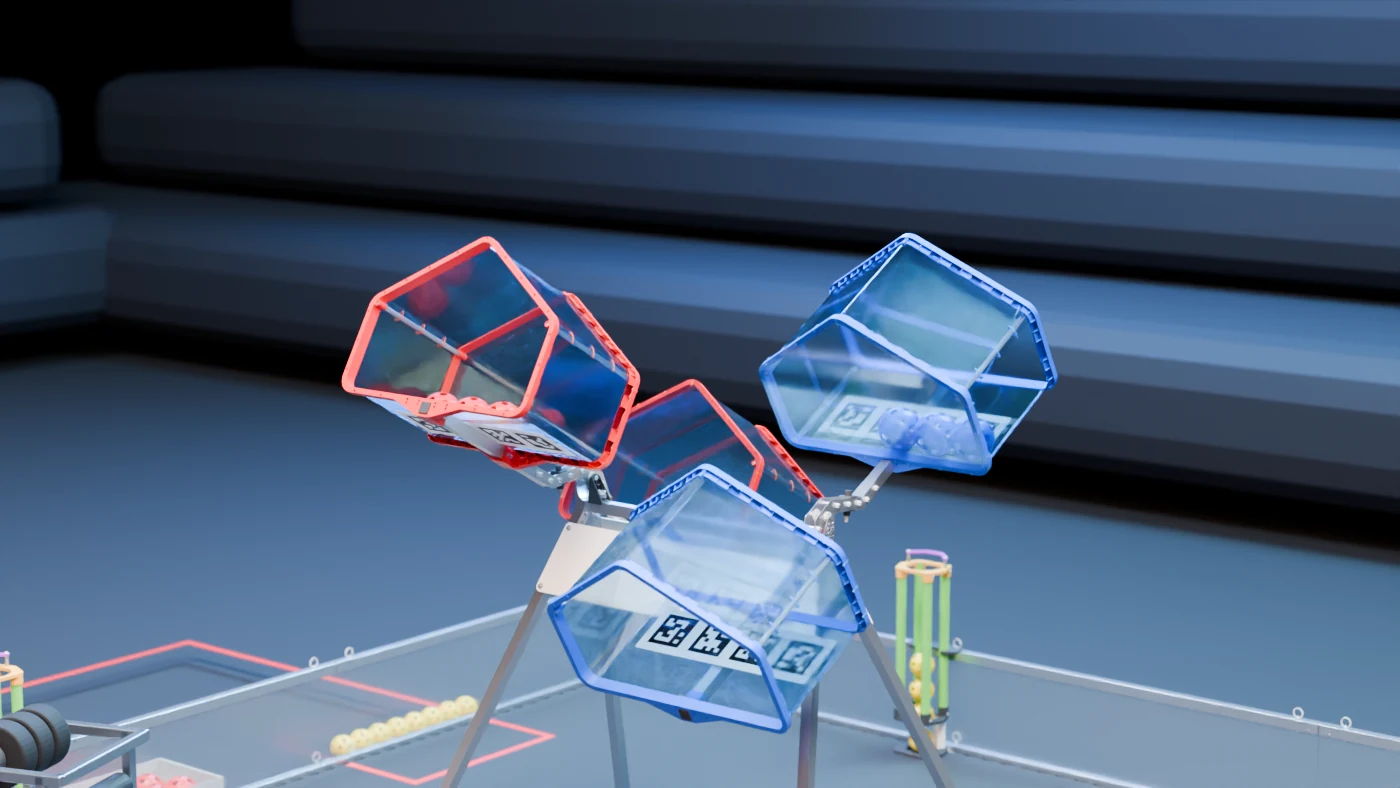
Cinematic BIOBUZZ HIVE used to study geometry and physical behavior
Digital Twins // Physics

See the invisible. Understand the possible.

Digital Twins help students explore how mass, friction, torque, launch velocity, geometry, and timing change the system—then compare those predictions with the physical field.

DriveMotor curves, gearing, traction, mass, and inertia
LaunchVelocity, angle, compression, spin, and bounce
FieldGeometry, collision, HIVE state, travel, and congestion
CalibrationPrediction error, physical measurement, and model revision
Roblox Simulation

Test strategy before hardware is finished.

Explore navigation, HIVE cycles, FLOWER timing, parking, traffic, and alliance spacing with a shared visual model.

How we use the Roblox Simulation →
Code

Keep software visible and teachable.

Programming has its own public home with Blocks diagrams, downloadable programs, math explanations, generated source, and a glossary.

Open Code Lab →
Growth Mindset

A growing toolset for growing ambition.

Harder problems invite new skills and better instruments—from CAD and fabrication references to physics simulation, source-backed team knowledge, and deployment tools.

Evidence boundary: Digital Twins and Roblox Simulation results are hypotheses, not proof of physical robot performance. Published test dashboards, subsystem revisions, CAD galleries, and measured physical results will be added only when current team evidence is ready.